Spring Park 3D Filmshow and Talk, 27 June 2013
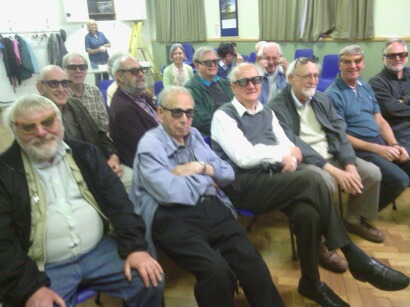
Spring Park Members at Meeting.
The big turnout for the session was partly due to the interest in 3D by our members.
We also asked members from another local film making club (Orpington) if they would
like to attend and a big group of them also came along.
Description
Spring Park 3D Filmshow and Talk
At the Griffiths-Jones Hall, Emmanuel Church
The Grove, West Wickham, Bromley, Kent
On Thursday at 7.45 to start at 8.00 pm, 27 June 2013

The talk will last about 2 hours and there will be a break at half time.

    Programme - High Reality Recording
Part 1
Demo of Stereo 3D filming
Current State of 3D TV
Samples of commercial 3D
- Terrestrial TV
- Satellite TV (Europe-wide)
- Cinema (Bluray)
Samples of home made stereo 3D
Discussion

Half Time Break

Part 2
Talk on High Realism Recording
This is about a particular style of movie making that I have adopted over
a period of time and intend to develop into the future. Styles are personal
things and the talk is intended to make you think about your own style,
what you like and dislike, what you do and don't do.

Discussion
-----------------------------------------

DETAILS OF THE 3D CAMCORDER

Experience with a 'prosumer' Sony HDR-TD10E Stereo 3D camcorder,

Fully automatic operation. For "Comfortable" 3D viewing, need to obey the
following rule:-

Optimum (Safe) Distances and zoom level

Full Wide Angle (W) 	3ft to 20ft

Midway  		8ft to 32ft

Full Telephoto (T) 	25ft to 65ft (to infinity)

HDR-TD10E Camera Plus Points

Dual processors - Full double HD quality.

Good optical image stabiliser.

Records to internal 64GB solid state disk (SSD). Can also record to removable
SD or MMC cards.

3D "lenticular" LCD viewing screen

Fully automatic.

Manual control over zoom, focus, exposure, 3D depth adjustment.

Gives a warning when 3D depth limit or safe distances (above) have been exceeded.

Good quality HD picture in AVCHD1080/50p Stereo 3D MVC format.

Is "fast" 3D at 50 Hz. It is played at double speed giving a smoother picture.

Records audio in 5.1 surround sound.

HDR-TD10E Camera Minus Points

Poor visibility on the 3D LCD screen in bright daylight
- leading to bad exposure and even failure to switch between RECord and STandBY, etc.

REC button difficult to find in dark (e.g. when filming in theatre).

Need to backup recordings onto a computer hard disk after every recording session
(or risk loss of recording). Need to manage occupancy of SSD to make room for
new recordings.

Slight flatness of layers.

Can't do close ups nearer than three foot.

-----------------------------------------

DETAILS OF TALK

High Realism Recording
Talk By Paul Clarke

This talk is about a particular style that I have adopted over a period of time.
I like watching replays but others might not. Styles are very personal things
and make producers/directors instantly recognisable - think of Hitchcock,
Chaplin, Spielberg, etc. There is no right or wrong about them. It is a matter
of personal preference, taste, opinion, like and dislike.

The first thing that I need to do is to explain what I mean by the term "High
Realism".

In our context I intend High Realism Recording to be such that it
'reproduces an experience as closely as possible to being there at the
time of recording'. Mainly this will be via the senses of sight and sound as
in traditional movie making. The test of High Realism Recording is to play
it back using suitable equipment. If done well it should give the recipients
(i.e. Viewer, listener, player) an experience that is as close as possible to the
original experience of the recorder (filmer) during everyday life. It is
truthful. It is immersive. It will try to exclude things such as unnatural
events, artificial effects, other added content such as music that wasn’t
present at the time of recording,

High Realism Recording can be regarded as a style, just as Impressionism
and Photographic are two styles of art with High Realism corresponding to
the latter. With High Realism Recording in mind, it is possible to indicate
how to use current recording and playback equipment and what to ask of
future equipment and it’s development.

To consider High Realism Recording with an open mind, we need to
understand what an 'effect' is. The dictionary describes it as a 'result
produced'. Effects are artificially produced recordings. I don’t make any
distinction between live effects, such as use of coloured lighting during
recording and artificial effects such as using a colour filter during computer
editing, particularly because so much of our modern world is artificial.

I would prefer natural light.

A theatrical show is real, a film is artificial. High Realism Recording
attempts to make the film of the theatrical show in such a way that, when
played, the experience is as close as possible to being at the theatrical show.
Ultimately the experience is in the mind of the beholder and will be
influenced by their former experiences. There are no rules for High Realism
Recording and it may be necessary to restrict it’s use to some part of, say, a
film, and resort to effects for the rest. High Realism Recording is therefore
more suited to genres such as documentary and particularly to outdoor
nature, travel and sport documentary, and less suited to cartoon, drama,
thriller and fantasy.

Elements
A film can be regarded as being made up of elements for each sense such as
the picture and the sound, which are very powerful, but it should not be
restricted to these. Movement and Touch can also be recorded, and
interaction.

Picture Element
Firstly consider the picture element of a film. The thing we are trying to
achieve is a recording of what we are actually seeing with our eyes at the
time.  Normal human vision is completely automatic and controlled by
reflexes and the brain. We tend to focus on a subject of interest but are also
aware of anything else on the periphery of our vision. When we are filming
with a camera, we have various controls at our disposal. We have to work
within other constraints such as avoiding camera shake, so we may use a
tripod to make the camera rock steady.

The following are some factors that need to be considered for High Realism
Recording

For picture colour and brightness, early film was black and white
(greyscale), now we have colour. We see in colour, so go for that. There are
different brands of colour (Technicolor) and resolutions, the number of
different colours that can be reproduced (bit-size for digital). Because there
may be loss of colour during the editing process, perhaps the aim should be
to go for slightly more colours than the eye can distinguish. Modern
cameras have 'red eye removal', Good. We don’t see eyes red.

For picture resolution, we have progressed through standard definition, high
definition, to 2K, 4K and Ultra high definition. This is the way to go. We
seem to be approaching the level of detail that is perceivable by the human
eye. As technology improves, and prices fall. Good resolution is becoming
available to all.  Note that artificially high definition by microscope or
telescope is not normally needed and can be considered as effects.

For picture stability, we are trying to copy the human eyes, which give a
steady picture even when walking or running and are seldom still. A slight
movement is used for awareness. This covers checking peripheral vision for
objects entering vision and for checking object closeness and for
forwards/backwards movement and depth. So the use of a tripod to make the
camera rock steady, should be regarded as an unnatural effect. A camera
looking through the front window of a moving car is a normal view for a
passenger.

For picture focus, the human eye makes the centre of attention sharp. They
are an improvement on focus controls that make the whole picture sharp or
place sharpness at a particular depth. Having a fixed (shallow) depth of field
is also artificial. The eye doesn’t work that way Autofocus systems on
cameras have improved greatly and are now quite rapid, but still not as fast
as the human eye. Automatic face recognition is a move in the right
direction. It could be extended to other objects?

For picture depth, The human has two eyes giving stereoscopic vision. 3D is
natural. This allows greater perception of depth. Stereoscopic 3D equipment
is moving in the right direction. However replay on a flat screen in 2D
cannot be natural, (it is an effect). Stereoscopic recordings may be able to be
replayed much more effectively on future equipment, possibly some form of
holography (holograms).

For picture shape, currently we are restricted to rectangular pictures
produced by narrow or wide lenses. The human eyes cover a very wide oval
shaped area with sharpness at the centre and less sharpness at the peripheral.
Playback on wearable vision glasses rather than on a flat screen may be an
improvement. Off-screen objects do not distract, as you can only see the
recorded film.

Picture Technique
For picture content, the use of the camera as if it was the person’s view is
one of the most natural techniques for producing High Realism Recording.
Use long cuts, slow pans, slow tracking. Very small sideways tracking to
bring out depth and distance, Use Stereo 3D to capture position in terms of
scene depth. Use head-high level shots. Use picture framing objects, such as
trees, windows, etc. Playback with stereo 3D television or projector screen.
Use wrap-around picture, e.g. semi-circular or dome screen.

Things to avoid are narrow field of view, shallow depth of field, very jerky
camera motion, that are not part of natural eye vision. The eye is not still, so
the camera should move in the same way as the eye.  Excessively bright
conditions should be avoided because the camera can’t reproduce what the
human sees. I suggest filming at another time.  Avoid rapid cutting - the eye
doesn’t rapid cut from scene to scene - particularly junk cuts as seen on
music videos.

Sound Element
Secondly consider the sound element of a film. When we are recording, the
thing we are trying to achieve is a recording of what we are actually seeing
with our eyes at the time. We have various camera controls for audio at our
disposal.

For sound sample depth, the human ear can distinguish quite detailed levels
of pitch, tone, volume, etc. Digital recording has progressed through 8 bit
(tinny telephone) to 16 bit (good CD) to 24 bit high detail. Human hearing
can distinguish sounds at about the 16 bit level but microphones record
many sounds that are outside the human hearing range. Dogs may hear
them. 24 bit sound has higher resolution than the ear can perceive but may
be desirable to allow for losses in processing.

For sound position, the human ear can determine the direction and distance
of origin of many sounds. Sound recording has progressed through mono,
stereo, surround sound and now to 3D sound. The three main developments
are binaural, Ambisonics and Dolby Atmos, with the latter used in many
cinemas.
Binaural places a microphone in each ear near to the eardrums and records
the sound that the individual actually hears. When played back it gives the
listener with earphones the impression that that they were present at the
location where the recording was made. This is because the sound is
'coloured' with the signature peculiar to the human ear.
Ambisonics introduces height to sound, providing a layer that 5.1 surround
sound cannot.
You would expect to have overhead and underfoot speakers, but they are not
necessary and only 4 speakers are used.
Dolby Atmos is said to envelope the listener, giving the illusion that there
are an infinite number of speakers all around and above them. It is being
used on Pixar’s film 'Brave'.

For sound type separation, the human ear can determine the type of many
sounds and can focus on any one type, for example speech in a noisy
environment. Current equipment is moving this way. There is software that
can extract speech from background noise and can remove background
noise, such as hiss, from recordings. There are microphones and software
filters can reduce wind noise.

Sound Technique
We are trying to capture and reproduce what the recorder actually heard.
Avoid camera wind noise that is unlike natural wind sound as heard by the
ear. Use surround sound recording. May need to re-take sound recording if
bad. Avoid situations where background noise obscures spoken words.
Playback with surround speakers or stereo earphones.

Other Elements

We are referring to touch, smell, taste and interaction. Many movie makers
ignore these completely. In the future they may not be able to do so.

Touch element
Now consider the touch element of a recording. The thing we are trying to
achieve is a recording of what we are actually feeling with our body at the
time. Our feet may be touching the ground. Our behind may be on a seat.
We may be thrown around in a car seat during turns or going over rough
ground. There may be wind in our hair, sun, rain or spray on our faces, an
arm grasping us, a dog or rat rubbing on our legs, and so on.

Many of these experiences can be reproduced in the 4D cinema. They add a
great deal to the realism of the experience. They need to be synchronised
with the recorded audio visual event. There can be moving chairs, fans to
produce wind, very fine spray blown over the audience to simulate rain or
water spray, under-seat fans and flappers to create feelings round the ankles,
etc.

Interaction element
Now consider the interaction element of a recording. The thing we are
trying to achieve is the possibility of the audience interacting with the
recording playback. Since the audience might not have actually been present
at the recording session, this will be an artificial fabrication.

Many of these experiences can be reproduced in the 5D cinema. Also
computer / video games contains this element. We should learn from them.

Conclusion
There is much ongoing research and rapid development in all these areas.
The final result of High Realism Recording is an experience next to being
there. The ideal recording equipment would do everything in 'Auto' mode
and give perfect results. This is increasingly becoming possible.

All of this is a consequence of going digital. There are continual
improvements in computer editing of movies. At the same time
computerisation of recording and playback devices is very rapid.
Increasingly, cameras, camcorders, mobile phones, cars, watches, GPSs,
sound recorders, televisions, DVD players, spectacles, clothes, domestic
devices, etc. are containing embedded intelligent functions from digital
computing. There is a convergence path between computers and almost all
other equipment. Computers having more devices attached and devices
having more computing embedded. If you consider people to be devices,
they can have added computing. It’s called 'Augmented Reality' and
'Computer Mediated Reality' and can change your perception of your
environment. Check it out.
The future is digital - plus a bit of human style.

You may like to think about your own style. Do you have one? Or is it a
style that is just like all the rest? It doesn’t have to be a style that
wins prizes or public acclaim, as long as you are happy with it,
that’s what matters.

10 Jun 13
Last Revised: 31 Jul 13